
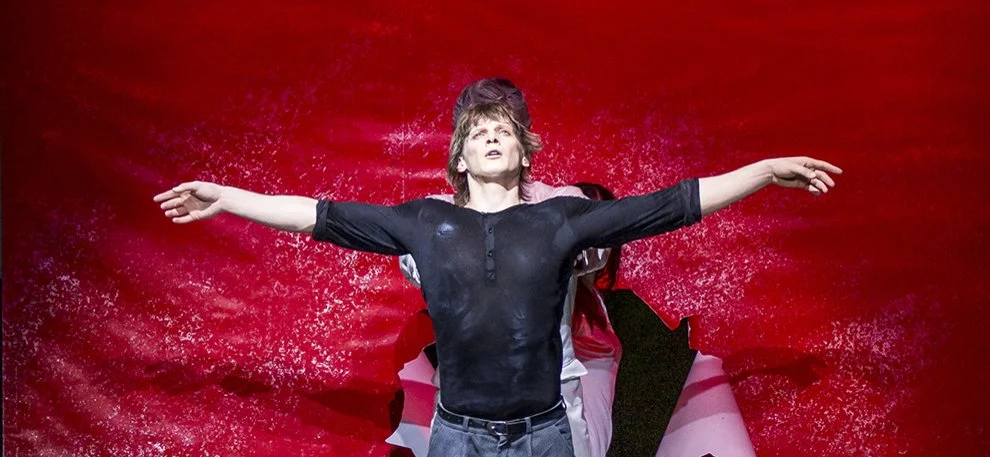
Hamlet 21
Ballet by John Neumeier based on Saxo Grammaticus and William Shakespeare
Music: Michael Tippett
Choreography, Staging and Light Design: John Neumeier
Set and Costumes: Klaus Hellenstein
2 hours | 1 intermission
Part I: 50 minutes, Part II: 40 minutes
PREMIERE:
The Royal Danish Ballet, Copenhagen, November 2, 1985 (under the title "Amleth")
ORIGINAL CAST:
Hamlet: Peter Bo Bendixen
Ophelia: Mette Bødtcher
Geruth: Linda Hindberg
Horvendel: Mogens Boesen
Fenge: Lars Damsgaard
Koll: Johnny Eliasen
Polonius: Tommy Frishøi
NEW VERSION 1997 – Hamlet:
Hamburg Ballet, Hamburg, May 4, 1997
ORIGINAL CAST:
Hamlet: Lloyd Riggins
Ophelia: Anna Polikarpova
Geruth: Laura Cazzaniga
Horvendel: Jirí Bubenícek
Fenge: Lars Damsgaard
Koll/Fortinbras: Ivan Urban
Polonius: Jean-Jacques Defago
NEW VERSION 2021 – Hamlet 21:
Hamburg Ballet, Hamburg, June 13, 2021
ORIGINAL CAST:
Hamlet: Edvin Revazov
Ophelia: Anna Laudere
Geruth: Hélène Bouchet
Horvendel: Marc Jubete
Fenge: Félix Paquet
Koll/Fortinbras: Christopher Evans
Polonius: Ivan Urban
Horatio: Nicolas Gläsmann
IN THE REPERTORY:
The Royal Danish Ballet (Amlet)
Hamburg Ballet (Hamlet / Hamlet 21)
TO BE READ BEFORE THE PERFORMANCE
By John Neumeier
The plays of William Shakespeare have been a continuous source of inspiration throughout my career. However, to be fascinated by and to work on one narrative for 45 years, there must be a good reason. Shakespeare's drama "Hamlet" is surely an iconic monument of world literature. Thousands of books have been written, attempting to interpret, decipher and to fully understand the drama's significance. It is a work we sense to be important, something we feel we should know about. Many of us studied "Hamlet" at school. Maybe, my own ballet should also begin in a schoolroom?
This thought inspired me to create a new frame for "Hamlet 21" – a further step in the evolution of my choreographic "Hamlet journey" spanning 45 years. It started in New York with the fragmentary "Hamlet Connotations", took me to Denmark with a fulllength "Amleth" including sets and costumes in a Viking style and later to Hamburg transferring the action to a modern era spanning the 1930s to the 1960s.
I have always searched for the center, the essence of this drama. In Shakespeare's "Hamlet", the ghost appears to his son and demands revenge for his murder. In this very moment, in which the desire for revenge is transferred from father to son, the central conflict of the play becomes apparent: the dilemma of a young man struggling to deal with his responsibility for the past.
To understand this dilemma, it is vital to know what happened, before Shakespeare's play begins. The text, of course, provides this important background. In ballet, however, there is no visual form to express the past. (There is no step indicating: his father wasmurdered.) To choreograph Hamlet's conflict, I have to show the past to the audience. Situations and characters from earlier sources helped me to develop a visually plausible concept that allowed the translation of information into dance. I took certain dramatic constellations from the "Gesta Danorum" of Saxo Grammaticus – a mythicalhistorical story about the Danish Prince Amleth – and adapted ideas from later sources. I believe it is legitimate to draw on various sources, if this leads to an individual and new "Hamlet". In other words, a work of art – inspired by a myth, a narrative or a masterpiece of another artist – derives its genuine meaning, its individual life from the specific perspective of the creating artist.
Giuseppe Verdi's "Otello", for instance, is a masterpiece. But, his "Otello" is not Shakespeare's "Othello". The opera may owe its existence to the composer's reading of the Elizabethan play, but we can enjoy and acknowledge it without knowing anything about Shakespeare's "moor". As the creator of a "Hamlet" ballet for today – and for tomorrow –, I had to discover a part of myself within the source material: the works of Shakespeare, Saxo Grammaticus and Adam Oehlenschläger.
Influenced by myth, history and Shakespeare, I looked for "Hamlet sounds" – music with the same archaic as well as human character, a musical world suggesting the atmosphere of a mythical pre-Christian time, the dramatic qualities of a Shakespeare drama as well as contemporary characters experiencing emotional situations of today. I found Tippett!
During the creation of the 1997 version, Michael Tippett's music was an important source of inspiration. For a long time, I had wanted to choreograph Tippett's Triple Concerto – without associating it with a specific theme. Later, this concerto became quite naturally a part of "Amleth".
SYNOPSIS
By John Neumeier
PROLOGUE
The Schoolroom
Polonius instructs Hamlet and Horatio in Latin and Danish History. To their imaginations, the lessons suggest the past so vividly that it seems reality. Hamlet becomes the Danish prince – Horatio his loyal friend.
ACT 1
// Michael Tippett: Symphony No. 2 (1958) //
Scene 1. Two Brothers: The War against Norway
Two brothers, Horvendel and Fenge, governors of Jutland, go to war against Norway. Geruth and Fenge share a secret attraction. However, she gives each of the brothers a band as a token of her support. Whoever wins the war, will win her in marriage. Horvendel kills the Norwegian King Koller in a duel and is victorious.
Scene 2. The Wedding of Geruth and Horvendel
Geruth marries Horvendel who is crowned King of Jutland.
Scene 3. Hamlet the Boy
Hamlet is born. As a boy, he is bored when playing war games, but is fascinated by three bizarre clowns. His heart, however, belongs to Ophelia, Polonius's daughter – a girl that loves flowers.
Scene 4. Fortinbras
The child Fortinbras, son of King Koller, mourns his father. When he matures, he mobilizes troops to avenge his father's death.
Geruth and Fenge surrender to their passion.
Interlude
// Michael Tippett: Divertimento for Chamber Orchestra "Sellinger's Round" (1953-54), 1st and 2nd movement //
Hamlet's Departure
Bidding farewell, Hamlet and Ophelia confess their love. Nonetheless, Hamlet is eager to study abroad and leaves Denmark.
ACT 2
// Michael Tippett: Triple Concerto for Violin, Viola, Violoncello and Orchestra (1978-79) //
Hamlet's Return to Denmark: The Drama
Ophelia waits for Hamlet. The Prince returns to Denmark for his father's funeral, only to learn that on the same day, the wedding of his mother and Fenge will be celebrated. The crown passes to Fenge – the new King of Jutland.
In mourning for her dead husband, Geruth welcomes Hamlet. Fenge abruptly ends the short period of mourning to prepare for his wedding with Geruth.
Hamlet visits Horvendel's grave. The dead king's ghost reveals to him that Fenge, his brother, is his murderer. The ghost demands that his son avenges his murder.
Haunted by the ghost of his dead father, Hamlet confronts his mother. Geruth dresses for her wedding. Angry and frustrated, Hamlet mistreats, then rejects Ophelia.
Confused, Ophelia loses her reason – she drowns.
Once again, Hamlet meets the three clowns. Escaping into their world of phantasies, he conceives a play that suggests Horvendel's murder.
Hamlet murders Fenge in a wild, mad dance.
Leading the Norwegian army, Fortinbras invades Denmark. Hamlet gives him the crown.
He is now King of Jutland.
Hamlet is free ...
EPILOGUE
The Schoolroom
"Good night, sweet prince"
Photo @ Kiran West