
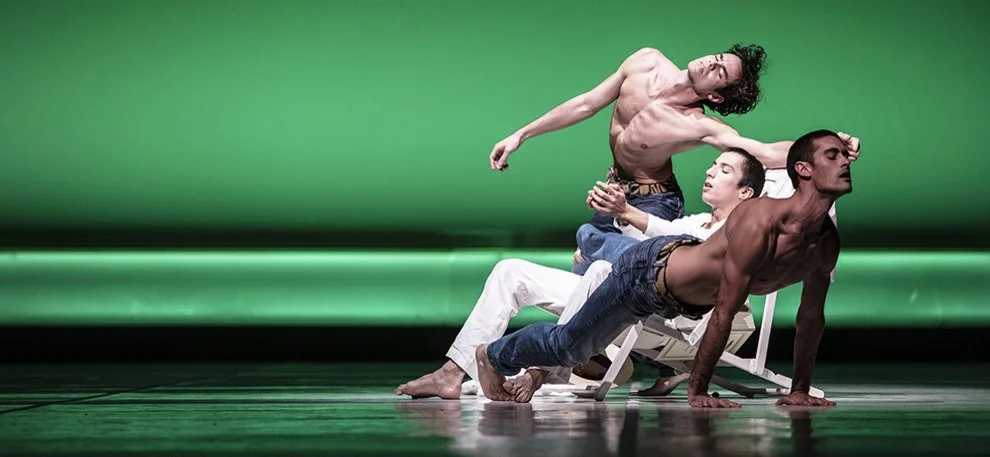
Death in Venice
A Dance of Death by John Neumeier based on the novella by Thomas Mann
What fascinates me in my interpretation of Thomas Mann’s novella is the depiction of absolute love. Tadzio causes Aschenbach to confront a hidden part of himself. Before meeting Tadzio, dignity, fame and his work which has gained him an aristocratic title have meant everything to Aschenbach. At first, he fights against his emotions justifying his fascination for the young man with purely aesthetic reasoning. Ultimately he surrenders to love – turning to life and bringing about his "Death in Venice".
John Neumeier
Music: Johann Sebastian Bach, Richard Wagner
Choreography and Staging: John Neumeier
Set: Peter Schmidt
Costumes: John Neumeier, Peter Schmidt
Light Concept: John Neumeier
2 hours 30 Minuten | 1 intermission
Part I: 60 minutes, Part II: 55 minutes
PREMIERE:
Hamburg Ballet, Hamburg, December 7, 2003
ORIGINAL CAST:
Gustav von Aschenbach: Lloyd Riggins
his assistant – his mother, Tadzio's mother: Laura Cazzaniga
Tadzio: Edvin Revazov
Frederick the Great: Ivan Urban
La Barbarina: Hélène Bouchet
Aschenbach's Concepts: Silvia Azzoni, Alexandre Riabko
The Wanderer, the Gondolier, a Dance Couple, Dionysos, the Hairdresser, the Guitar Player: Jirí Bubenícek, Otto Bubenícek
A young Aschenbach: Anton Alexandrov
Jaschu, Tadzio's friend: Arsen Megrabian
SYNOPSIS
Part I
I – Fame and Creation
His name and fame firmly established, the great choreographer Gustav von Aschenbach begins work on a new ballet based on the Prussian King Frederick the Great. Aschenbach is the acclaimed master of formal symmetry and structure – his ballets are modern classics. But now, the artist's fear of not finishing, of failure, clouds his vision. Panic impedes creation. The “Frederick Project” should be his masterpiece, but his concept becomes more and more obscure and confused. Unconscious memories of his poetic, impulsive dead mother distract him from his work. The court ballerina “La Barbarina” and Frederick the Great, characters of his creative imagination, appear, seeming to demand choreographic form and immortality. A crisis…
II – On the Brink of Exhaustion
Frustrated and exhausted Aschenbach abandons his work. An encounter with a mysterious stranger arouses his thirst for travel.
III – A Sensation of swimming – The Journey to Venice
The desire to get away overcomes him. He travels to Venice. A strangely familiar gondolier brings Aschenbach across the Lagoon to the Lido.
IV – The Silent Encounter – Hôtel des Bains
In the lobby, the elegant Venetian society promenades. Their glances of recognition and obvious awareness of his celebrity intensify Aschenbach's discomfort. Two effeminate young men dance outrageously with each other, then flirt with Aschenbach. Irritated he begins to leave. Tadzio, a strikingly beautiful young man, enters barefoot. The youth engages Aschenbach's attention, fires his imagination. He stays…
Part II
V – Elysium – On the Lido
The Beach. Aschenbach observes the playful activities of Tadzio and his companions. The sun seems to turn his attention from intellectual to sensory perception. Tadzio's smile overwhelms Aschenbach. Inspired by Tadzio's presence, he choreographs a pas de deux of true emotional love.
VI – A Dionysian Dream
Aschenbach falls asleep on the beach. An orgiastic dream overtakes him: bodies, tumult and frenzied erotic dance. He gives himself over to the Other God. Unnerved and shattered Aschenbach awakes.
VII – Metamorphosis
With a hairdressing gown draped over him, Aschenbach leans back in the chair: "We are only so old as we feel in our hearts and minds. A man in your position has a right to his natural hair colour" says the barber.
VIII – Dance of Death – Cholera in Venice
A Street Musician gives a vulgar performance in the hotel garden. The player is brutal and bold, dangerous and relentless. Hotel guests fall ill – and die.
IX – The pure sound of the Piano: Decision and Farewell
Nevertheless, Gustav von Aschenbach decides to stay. He lets go of his art, his artistry, destroys his creations. His "Frederick the Great" will remain unfinished...
X – Liebestod
Aschenbach turns from art to life – and death in Venice.
WEGE NACH VENEDIG
John Neumeier choreografiert frei nach Thomas Mann
"Tod in Venedig", an diesen Titel hat jeder bestimmte Erwartungen, er löst eine ganze, mehr oder weniger lange, Kette von Assoziationen aus: Da ist die Stadt Venedig – selbst schon ein Mythos, der Strand mit dem ewig wogenden Meer, aber vor allem natürlich der wohl situierte und etablierte alternde Künstler, der angesichts der Schönheit und Jugend des Knaben Tadzio sein gesamtes Lebenskonzept aufgibt..." John Neumeier ist sich bewusst, welche Herausforderung die choreografische Arbeit zu Thomas Manns Novelle bedeutet.
Vielen mag die Visconti-Verfilmung von "Tod in Venedig" – in der von Aschenbach Komponist ist – präsenter sein als der Text von Thomas Mann. So verleitet die Novelle in Verbindung mit einer Choreografie von John Neumeier leicht zur scheinbar kausalen Vermutung: 'Es wird bestimmt ein Ballett zu Musik von Gustav Mahler'. John Neumeier hat jedoch eine ganz andere Musikauswahl getroffen. "Um die Dualität im Wesen und Benehmen von Aschenbachs zu verdeutlichen habe ich zwei gegensätzliche Komponisten gewählt. Mein Ballett beginnt mit dem "Musikalischen Opfer" von Johann Sebastian Bach. Dieser so regelhaft strengen Komposition habe ich Stücke von Richard Wagner gegenüber gestellt, die größten Teils vom Klavier gespielt werden. Ausgangspunkt ist hier die im Wesentlichen in Venedig entstandene Komposition "Tristan und Isolde". Ihr verwandte Stücke und Skizzen Wagners unterstreichen die eher 'rauschhafte' Gegenseite."
Thomas Mann schrieb die Novelle "Tod in Venedig" 1911/12 nach seinem Sommeraufenthalt mit seiner Frau Katia und dem Bruder Heinrich in der Lagunenstadt. Die Publikation im Herbst 1912 sorgte für großes Aufsehen. Der Autor des Erfolgsromans "Die Buddenbrooks" schrieb plötzlich über ein absolutes Tabuthema: Die Liebe eines Mannes zu einem Jüngling. Bemerkenswert ist, dass die Beziehung zwischen dem Schriftsteller von Aschenbach und dem Jungen Tadzio den Protagonisten bis ins Mark erschüttert, obwohl sie nur platonischen oder allenfalls voyeuristischen Charakterhat. Kein einziges Wort wechselt von Aschenbach mit Tadzio und teilt sich auch sonst mniemandem mit. Er öffnet sich der Faszination und seinen Gefühlen so ausschließlich, dass er sich wehrlos der nahenden und tödlichen Cholera aussetzt.
Thomas Mann beschreibt die Wandlung eines scheinbar gefestigten Charakters. Von Aschenbach befindet sich im Spannungsfeld vom streng geordneten, pflichtbewussten apollinischen und rauschhaft-verwirrenden, launenhaften dionysischen Prinzip.
"Mich fasziniert an Thomas Manns Text das, was ich als Beschreibung der absoluten Liebe interpretiere", sagt John Neumeier. "Tadzio ist der Auslöser dafür, dass der Mensch von Aschenbach mit seiner anderen Seite konfrontiert wird. Seine Würde war ihm alles, seine Arbeit brachte ihm sogar den Adelstitel. Bei mir im Ballett ist von Aschenbach ein Meisterchoreograf. Zunächst kämpft er gegen seine Emotionen an und findet für seine Faszination eine rein künstlerische Berechtigung, doch er muss sich hingeben. Und diese vollkommene Hingabe bedeutet seinen "Tod in Venedig".
Telse Hahmann
Photo © Kiran West