
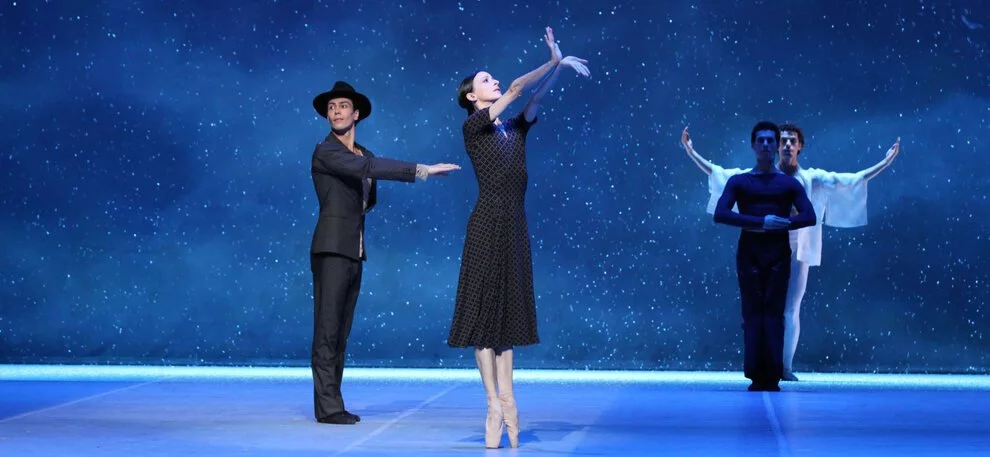
Seven Haiku of the Moon
Ballet by John Neumeier
Music: Arvo Pärt, Johann Sebastian Bach
Haiku: Basho, Buson, Issa, Shiki, Sodo
Choreography, Set and Light Design: John Neumeier
Costumes: Yukiko Hanai
45 minutes | no intermission
PREMIERE:
The Tokyo Ballet, Tokyo, July 21, 1989
ORIGINAL CAST:
The Moon: Kazuo Kimura
Contemplators of the Moon: Yukari Saito, Naoki Takagishi
IN THE REPERTORY:
The Tokyo Ballet
Hamburg Ballet
TO BE READ BEFORE THE PERFORMANCE
It is surely impossible to dance a Haiku. But, I believe, there is a parallel be tween the Japanese poetic form and dance. Firstly, both arts suggest more than what is actually said, or shown. And, just as Haiku pin-points a particular instant of time, sharply observing and comparing concrete images to suggest cosmic unity, so may dance use the reality of the human body, moving through time and space, to evoke something universal or metaphysical.
Fascinated by this relationship between the two arts, I have arranged a series of "visual Haiku" joining dance, music, and spoken text. However, my ballet does not illustrate the Haiku which inspired me, but establishes images independent of the poems. Similar to Haiku Painting, this combination of text and movement results in a dialogue – a new form revealing insights neither word or dance alone could express, and thus expanding the meaning of the poems. One might ask, are the spoken Haiku the thoughts of the dancers while "moon viewing", or are the dances visions provoked by hearing the words of the Haiku?
Arvo Pärt's music seemed ideal for the abbreviated, concentrated, profoundly simple Haiku form. During my preparations I heard a sarabande of Pärt's, which quotes Johann Sebastian Bach. Suddenly struck, not only by the calligraphic similarity of Bach's name to that of the poet Basho—, I realized that the two great artists had lived at the same time (J. S. Bach 1685–1750—Basho—1644–1694)—had looked at the same moon. It seemed right that some of J. S. Bach's music be woven into the ballet.
The ballet tells no particular story, but suggests many. Following the seasons, from Autumn to Autumn, moon images unite the dances. A moon framed by the "reflection of the night sky" touches its viewers.
John Neumeier
HAIKU AND THE MUSIC
Reflection of the Night Sky
Music: Johann Sebastian Bach, Andante from Sonata for Flute and Continuo, BWV 1034
What a red moon!
And whose is it,
children?
Issa
Music: Arvo Pärt, "Arbos"
They look like men
on moonlight nights and scarecrows
draw one' pity then
Shiki
Music: Arvo Pärt, "Perpetuum mobile" op. 10
On people, four or five
the moon begins to set –
the circle-dance!
Buson
Music: Arvo Pärt, Sarabande from "Collage über B-A-C-H"
Reflection of the Night Sky
Music: Johann Sebastian Bach, Sicilienne from Sonata for Flute and Harpsichord, BWV 1031
Icy the moonshine:
Shadow of a tombstone,
Shadow of a pine.
Shiki
Music: Arvo Pärt, "Dreiklangskonzert", 1st Movement
Spring too, very soon!
They are setting the scene for it –
Plum tree and moon.
Bashō
Music: Arvo Pärt, "Dreiklangskonzert", 2nd Movement
My grumbling wife
if only she were here!
This moon tonight...
Issa
Music: Arvo Pärt, "Dreiklangskonzert", 3rd Movement
Leading me along,
my shadow goes back home
from looking at the moon
Sodō
Music: Arvo Pärt, "Cantus in Memory of Benjamin Britten"
As bell tones fade,
blossom scents take up the ringing
evening shade!
Bashō
Photo © Holger Badekow